Music Scales for Beginners
Learn what a music scale is, how whole and half steps build major and minor scales, why pentatonic scales use fewer notes, how the Greek modes work, and how scales connect key signatures, chords and melodies.
Recommended learning path
This lesson is easier if you already know how notes are read, how key signatures work, and how scales connect to chords. If any of these ideas are new, review the earlier lessons first.
What Is a Music Scale?
A music scale is an ordered group of notes. We usually hear it from a starting note — the tonic or root — and move upward or downward through a specific pattern of intervals.
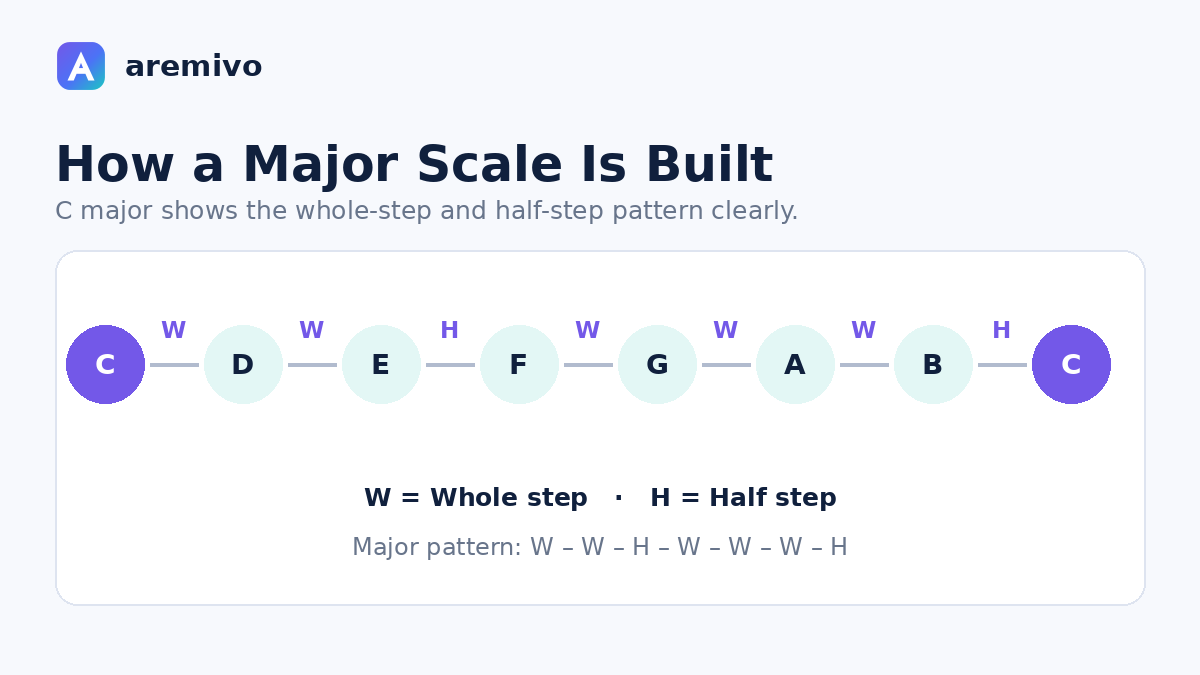
This is the C major scale. The first and last C sound like the same note at different octaves, and the notes between them follow the pattern that defines a major scale.
How a Major Scale Works
A major scale contains seven different notes before the octave repeats. Its characteristic sound comes from the distance between consecutive notes.
Whole Steps and Half Steps
Half step (H)
A half step is the smallest distance between adjacent keys on a piano, including a white key to a neighbouring black key or E to F and B to C.
Whole step (W)
A whole step equals two half steps. For example, C to D is a whole step because C♯ lies between them.
The order of whole and half steps is what gives each scale type its structure. This same idea will later connect directly with intervals.
Major vs Natural Minor Scales
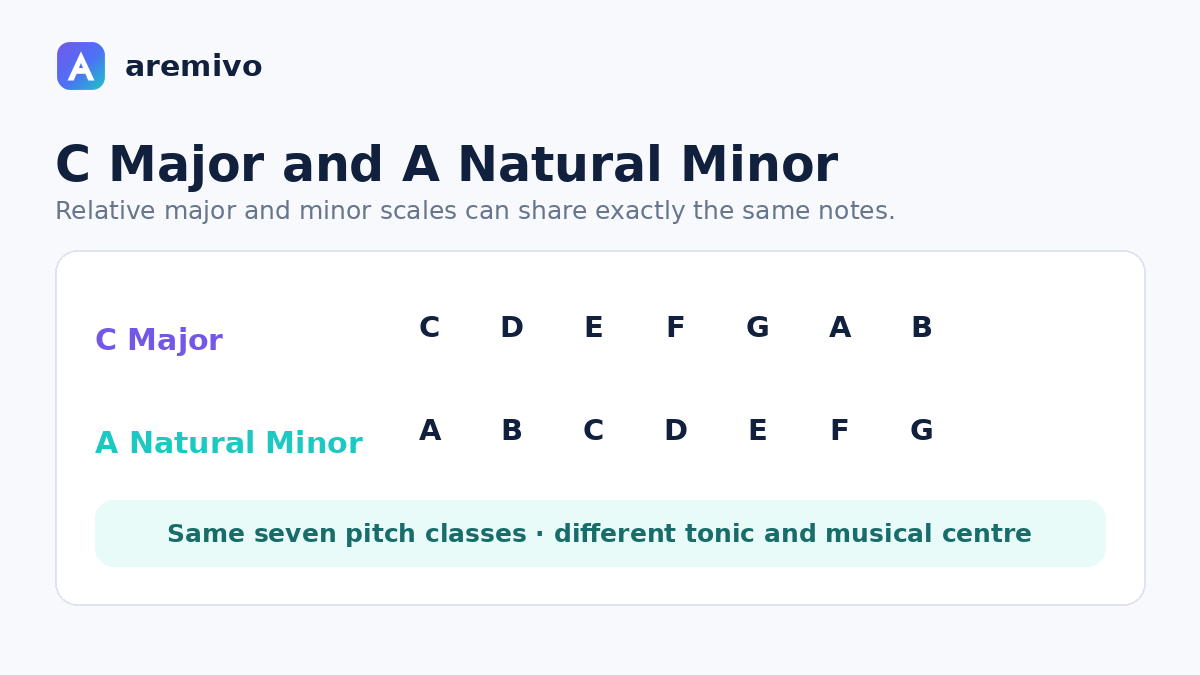
The natural minor scale uses a different degree pattern from the major scale:
A useful relationship is the idea of relative major and minor. Two relative scales can contain exactly the same pitch classes but use a different tonic.
What Is a Pentatonic Scale?
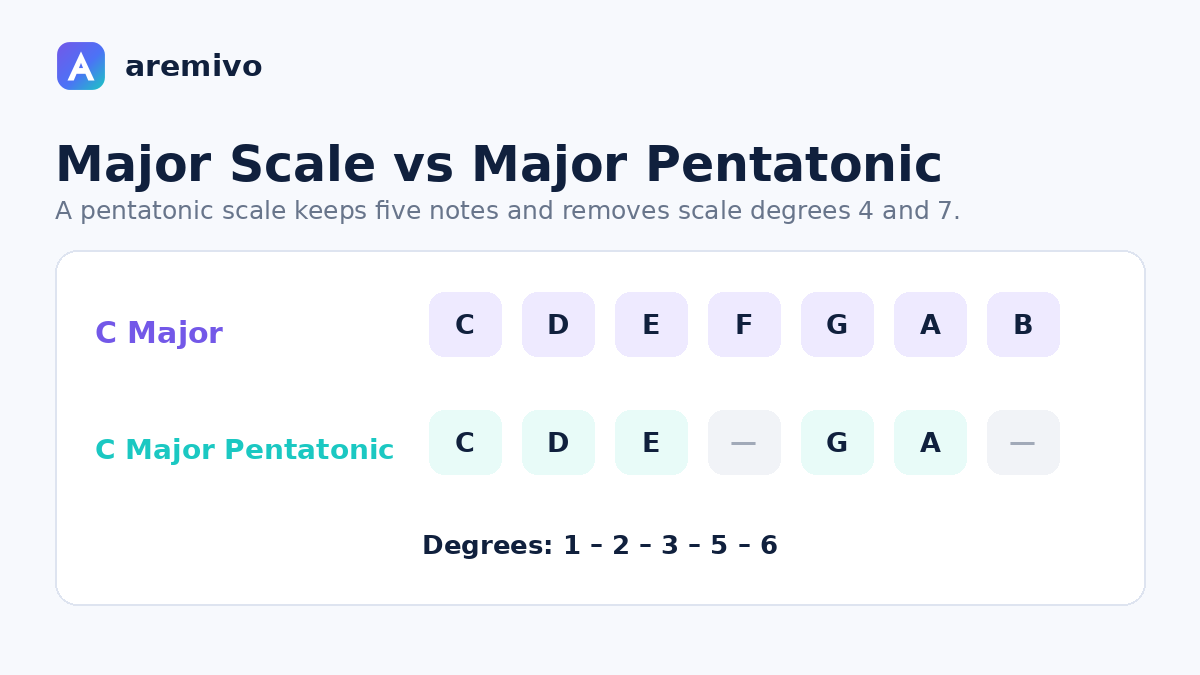
Pentatonic means five notes. A major pentatonic scale keeps degrees 1, 2, 3, 5 and 6 of the major scale. Removing degrees 4 and 7 creates a compact set of notes that is especially useful for melodies and improvisation.
The minor pentatonic follows the same idea around a minor tonal centre and uses degrees 1, ♭3, 4, 5 and ♭7.
What Are the Greek Modes?
The Greek modes are seven related scale patterns. A useful way to understand them is to take the notes of a major scale and make a different scale degree feel like the tonic. Each mode has its own interval pattern and characteristic sound.
Ionian and Aeolian
Ionian uses the same interval pattern as the major scale. Aeolian uses the same pattern as the natural minor scale.
The other five modes
Dorian, Phrygian, Lydian, Mixolydian and Locrian alter particular scale degrees, giving each mode a distinct colour while keeping a seven-note structure.
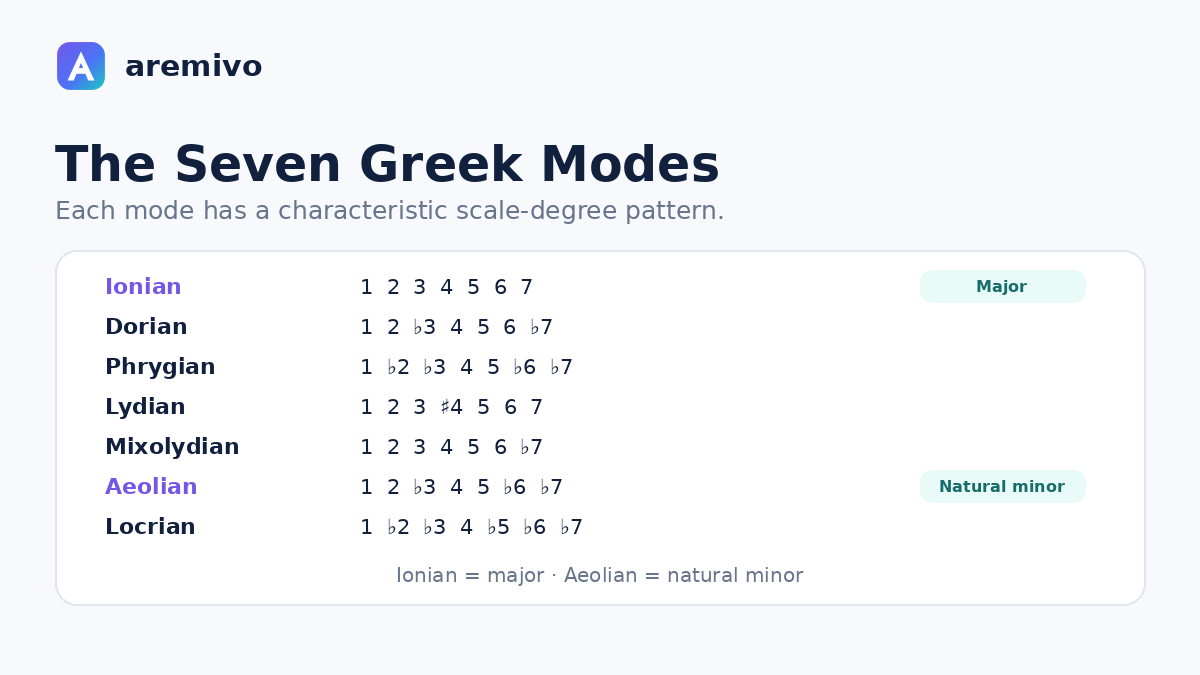
You do not need to memorise all seven at once. Use the Scale Explorer to compare a mode with Major or Natural Minor and notice exactly which scale degrees change.
How Scales Relate to Key Signatures
A key signature tells you which notes are normally sharpened or flattened in a key. A scale shows those notes in order from its tonic. That is why correct musical spelling matters.
F major
The key signature contains B♭, so the scale is written with B♭ — not A♯.
G major
The key signature contains F♯, and that spelling appears in the scale.
How Scales Are Used to Create Melodies
A scale gives you a palette of notes that belong naturally to a tonal context. When you create a melody, you can move through those notes while the harmony underneath changes.
Some scale notes will also be chord tones at a particular moment. Those notes often sound especially stable over the current chord. This is the bridge between scales, chord progressions and improvisation.
See the scale. Hear it. Play it.
Choose a root and scale type, see the correct notes on the staff and piano, play the scale automatically, touch individual keys and compare two scales side by side.